
Unlike our competitors, you can integrate STRATUM quickly and easily into your existing ecosystem and not worry about added security or compliance issues. Everything surrounding our small surface area is from Platform One’s Iron Bank or from your own vetted and approved Linux operating system.
Turn the same building into a product. Sell outcomes, not hardware. Deliver virtual infrastructure as a product.
STRATUM lets MSPs transform physical infrastructure into metered, sellable virtual datacenters. Instead of selling racks, static hosting, or one-off managed environments, providers can offer customers drag-and-drop virtual datacenters with compute, networking, storage, security controls, GPU resources, and port-to-port wiring delivered as a managed service.
Each customer can bring their own applications, databases, VMs, Kubernetes clusters, cyber ranges, or enterprise workloads while the MSP controls the underlying AI cloud rack, template marketplace, resource metering, and service catalog. STRATUM makes it possible to operate a datacenter of datacenters—many isolated customer environments running on shared infrastructure, billed by the hour, expanded on demand, and managed like software.

Sell metered virtual infrastructure, not static hardware. Scale tenants like software.
STRATUM lets MSPs deploy customer infrastructure as repeatable, containerized virtual datacenters. Each tenant can receive an isolated environment with its own VMs, networks, switches, routers, firewalls, storage, GPU resources, templates, and wiring, while the provider manages the shared physical capacity underneath.
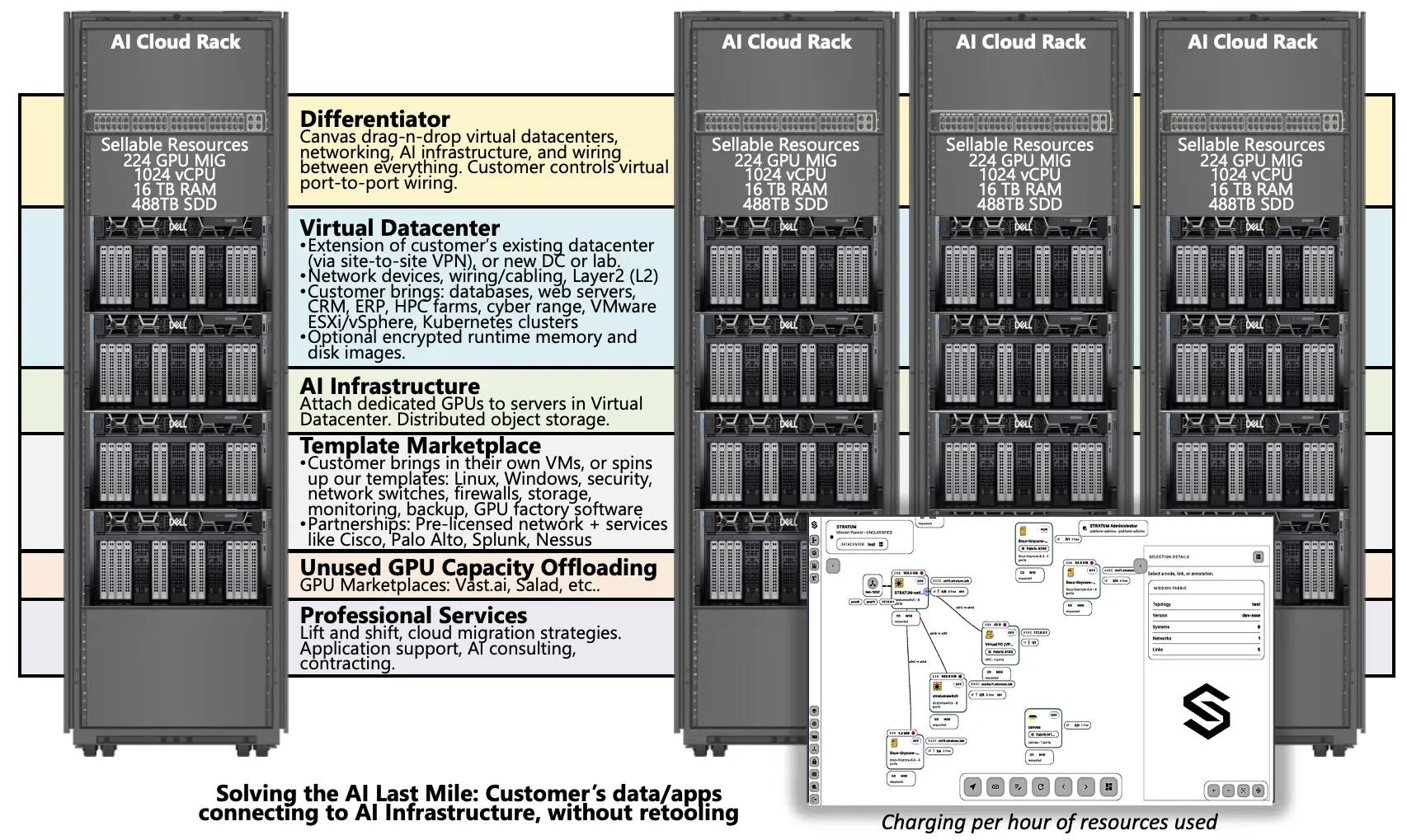
When deployed on Kubernetes, STRATUM becomes a scalable datacenter cell. MSPs can stamp out new customer environments, expand capacity across worker nodes, assign GPUs and storage, apply quotas and policies, and meter usage by the hour. Instead of manually building custom racks or one-off virtualization stacks, providers can operate a datacenter of datacenters using the same automation, scheduling, and DevSecOps pipelines already used for modern applications.
STRATUM changes the scaling model for virtualization. Instead of building one large, fixed virtualization platform and manually carving it into customer environments, STRATUM packages complete virtual datacenters as deployable containerized infrastructure.
Each STRATUM deployment can contain the virtual machines, switches, routers, firewalls, storage fabric, GPU resources, templates, wiring, and operational state needed to deliver a customer environment. That means an MSP can deploy infrastructure the same way modern cloud teams deploy applications: as versioned OCI artifacts, scheduled, scaled, upgraded, and moved through Kubernetes.
With Kubernetes underneath, STRATUM becomes a repeatable datacenter cell. One cell may serve a customer, a lab, a cyber range, an AI workload zone, a regional point of presence, or an internal business unit. More demand does not require redesigning the platform. The provider adds more Kubernetes worker capacity, deploys more STRATUM cells, and assigns tenants to isolated virtual datacenters.
STRATUM supports multi-tenancy at two layers.
At the provider layer, Kubernetes separates STRATUM deployments using namespaces, node pools, resource quotas, storage classes, network policies, GPU scheduling, and operational controls. Each tenant environment can be deployed, limited, monitored, upgraded, or removed independently.
Inside STRATUM, each customer receives their own virtual datacenter: isolated networks, virtual switches, routers, firewalls, VM templates, storage mappings, GPU assignments, and port-to-port wiring. Customers see and operate their own infrastructure design, while the MSP controls the underlying physical capacity, policy, metering, and service catalog.
This creates a datacenter of datacenters: many customer-controlled virtual environments running on shared provider infrastructure, without every customer needing dedicated racks, dedicated hardware, or a custom-built private cloud.
STRATUM scales by repeating known-good infrastructure patterns.
An MSP can define a standard virtual datacenter blueprint once, package it as a containerized deployment, and stamp it out many times. A small customer may receive a lightweight STRATUM environment with a few VMs and networks. A larger customer may receive a full AI cloud rack abstraction with dedicated GPUs, distributed storage, cyber range services, and enterprise templates.
Kubernetes (optional.. you can use STRATUM with standard docker/podman) then provides the operational machinery around that model: placement, restart, health checks, rolling updates, capacity expansion, image promotion, node affinity, and integration with GitOps or CI/CD pipelines.
The result is that virtual infrastructure can be scaled more like software:
The datacenter: Build once. Version it. Deploy it repeatedly. Meter it. Upgrade it. Move it. Retire it.